The gate
The strait had an owner long before it had a crisis.
For roughly a hundred and fifty years the Persian Gulf was a British system. Not conquered — contracted. Kuwait, Bahrain, Qatar and the Trucial States that became the United Arab Emirates were protectorates until 1971, and Oman's treaties with London limited what it could do abroad without asking.
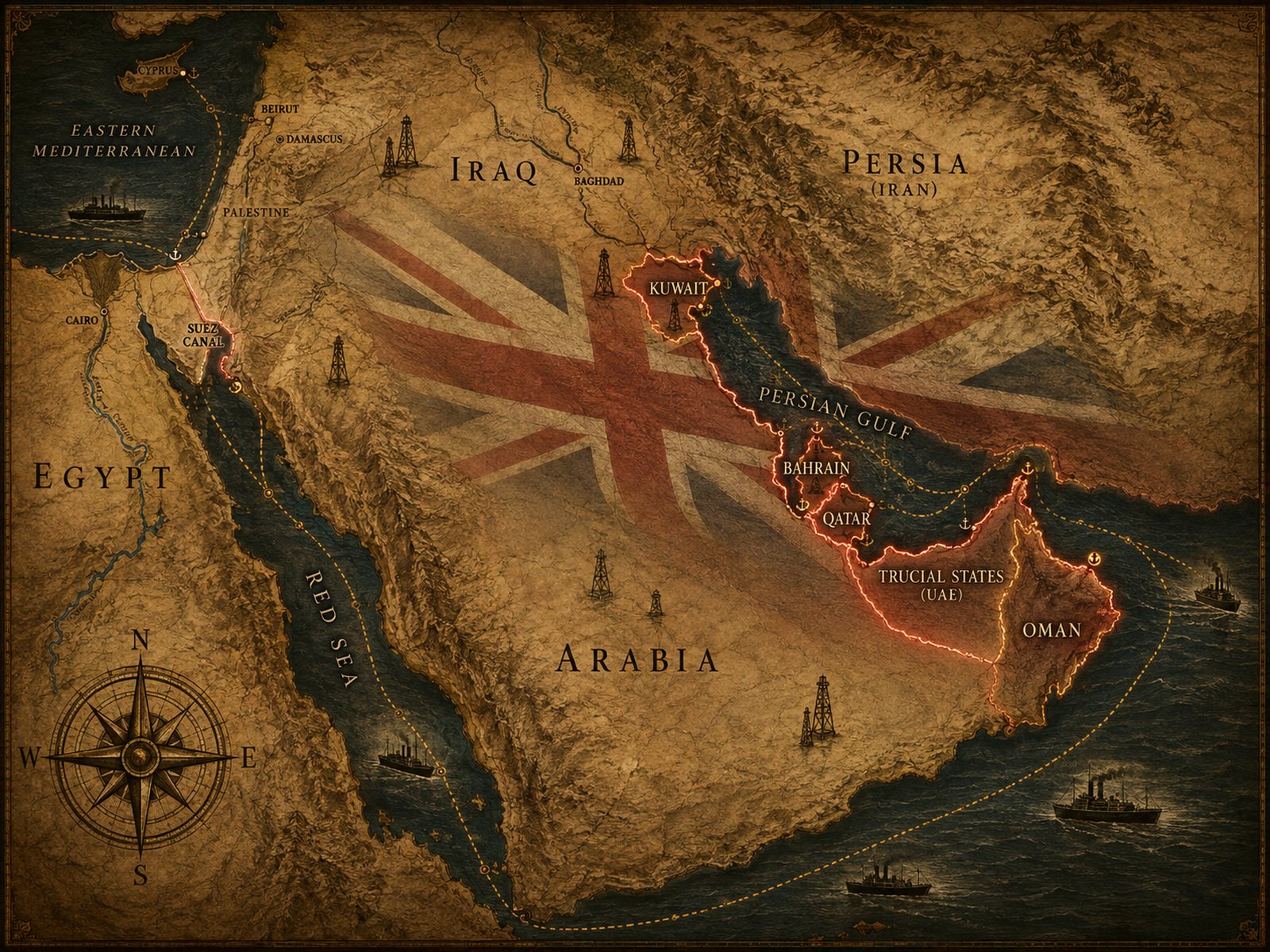
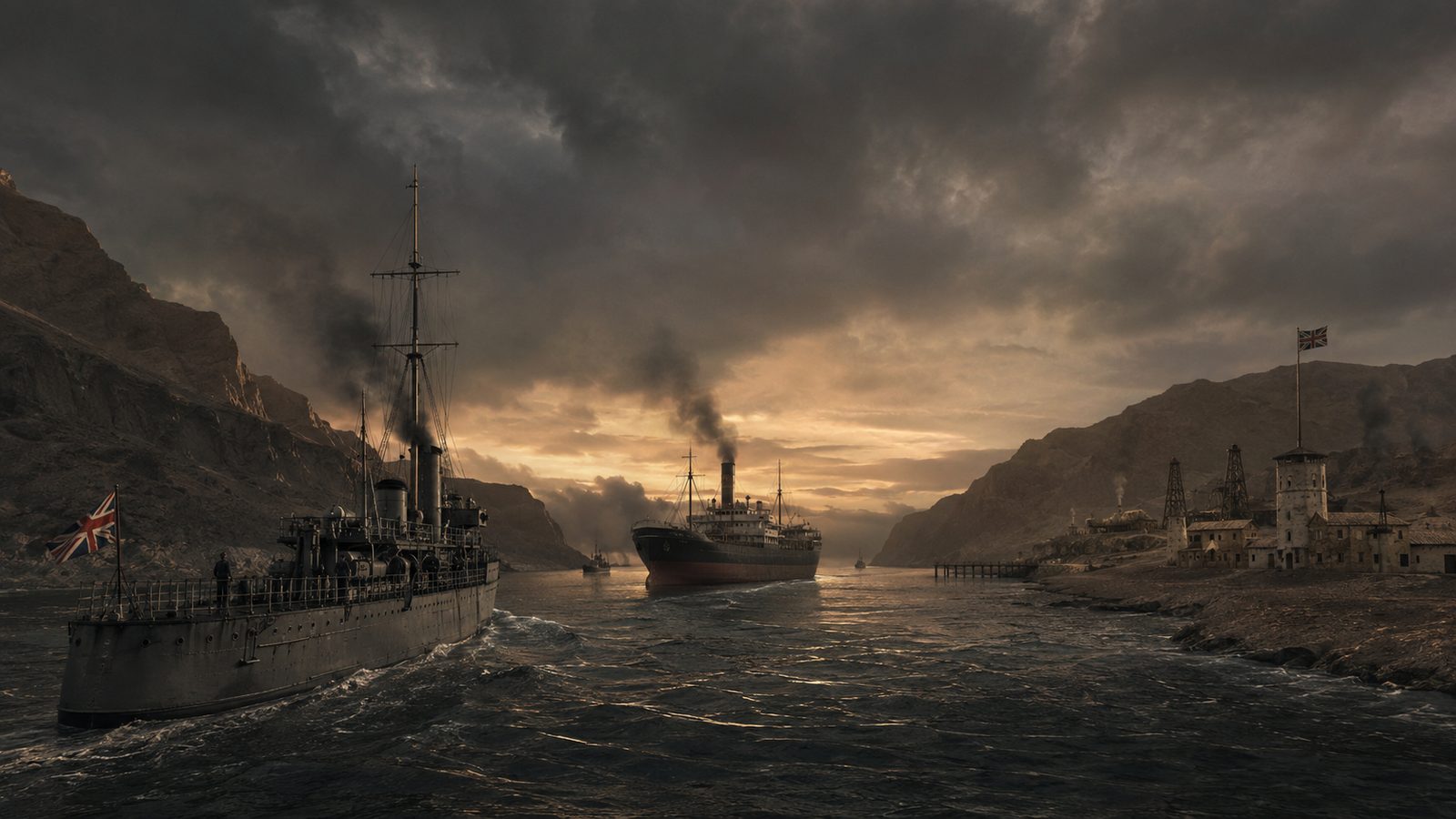
the-fuse-has-been-lit-british-gulf-map.jpgThe machinery was modest: residencies, naval and air facilities at Bahrain and Sharjah, local defense handled by British-raised units. A few thousand men holding the throat of the world's energy supply.
The interesting question was never who guarded the gate.
It was who paid for it.
In 1913 Winston Churchill, then First Lord of the Admiralty, wanted the fleet off coal and off anyone else's price. On June 17, 1914 he put the bill to the Commons: £2.2 million of public money for a fifty-one percent stake in the Anglo-Persian Oil Company, plus two government directors on its board with veto power over every act of the company.
Read the loop that created. The state bought the oil company to fuel the navy; the navy was in the Gulf to protect the oil company. Each existed to justify the other, and the public paid for both.
None of it was hidden. Churchill argued it on the floor of the Commons, and The Times predicted that May that the deal would reshape British policy in the Middle East for a generation. It did.
All of it is in Hansard. The empire wrote its intentions down, voted on them, and printed them in the newspaper.
Anglo-Persian became Anglo-Iranian in 1935, and British Petroleum in 1954.
The first crack came in 1951, when Iran nationalized it — Britain's largest single overseas investment, and not survivable politically. In 1953 Mohammad Mossadegh was removed. British intelligence conceived the operation. American intelligence carried it out.
That was the tell, and almost nobody read it at the time. The gatekeeper could no longer hold the gate alone.
It would be another eighteen years before anyone admitted why.
the-fuse-has-been-lit-british-gulf-1914.jpg1971
On January 16, 1968, Prime Minister Harold Wilson announced that Britain would withdraw all forces east of Suez by the end of 1971.
The reasons given were the collapse in Aden and the sterling crisis. The second was the real one. Devaluation of the pound pulled the timetable forward from the mid-1970s to 1971 — the empire left the Gulf because it could no longer afford to stay, and it could no longer afford to stay because its currency had broken.
Washington was not consulted and was not pleased. British forces left the Gulf on December 1, 1971.
Now set that next to the other thing that happened that year.
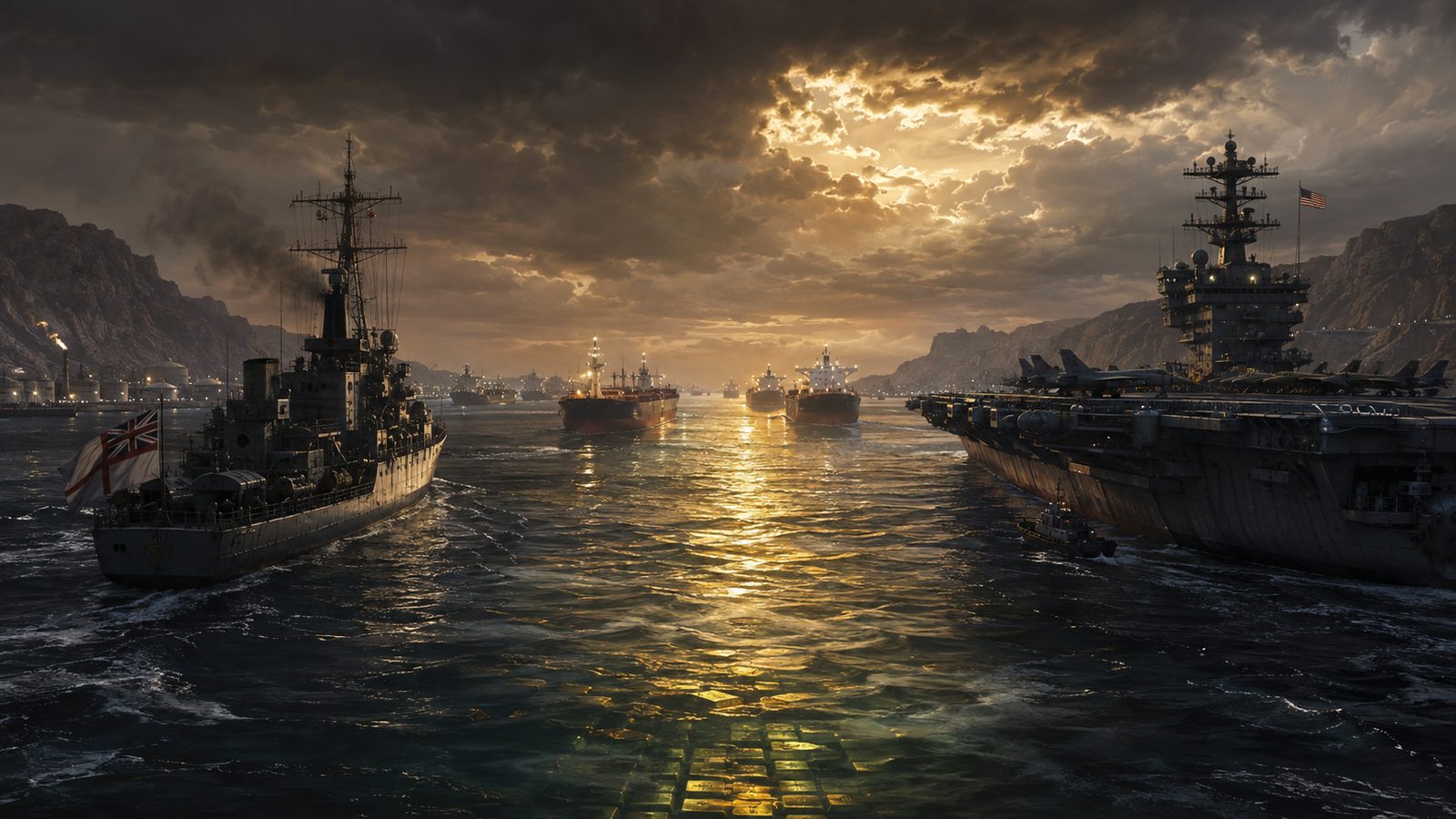
On August 15, 1971, the United States closed the gold window. The dollar stopped being convertible. Four months later the power that had guarded the strait for a century and a half sailed home.
Three years after that came the understanding with Saudi Arabia. Oil had been priced in dollars for decades already; what was new was where the dollars went afterward — recycled back into American government debt. The currency had lost its backing in metal and quietly acquired a different one: the willingness of the people selling oil to hold American paper.
The gatekeeper and the reserve currency were never two jobs.
They changed hands together, in the same year, for the same reason. Britain's currency failed and Britain gave up the gate. America took the gate and within twelve months redefined what its currency was. Nobody arranged that. It didn't need arranging — the two were one thing, moving together the way a shadow moves with the body casting it.
the-fuse-has-been-lit-handover-1971.jpgWorth remembering fifty-five years later, watching a currency come under pressure and a strait fall quiet in the same season.
The chairs
What happened in the fifty-five years between is easy to miss, because it never once looked like an event.
On January 16, 2013, the Bundesbank announced it would bring 674 tonnes of German gold home — 300 tonnes from the Federal Reserve Bank of New York, 374 from the Banque de France — with the aim of holding half of Germany's reserves inside Germany by 2020. It was done by 2017, three years early. The stated reason was domestic confidence. The unstated one was simpler: a bar in Frankfurt has no counterparty.
Then in 2022 something clarified the whole question for everyone at once. Roughly $300 billion of Russian central bank reserves were frozen. Not seized in a war, not lost in a crash — switched off by decision.
Every reserve manager on earth drew the same conclusion. Paper held abroad is a promise somebody else can cancel. Gold in your own vault is not.
Central banks bought over a thousand tonnes a year for three consecutive years afterward. Poland, Turkey, China, India, the Central Asian states. Some stopped reporting what they were buying at all.
And the empire that had walked out of the Gulf in 1971 had not gone anywhere. It had changed what business it was in.
In March 2015 the United Kingdom applied to become a founding member of the Chinese-led Asian Infrastructure Investment Bank — over the objections of its own Foreign Office and of Washington, and ahead of every other Western country. Germany, France, Italy, Australia, South Korea and Israel followed within weeks. By December the bank had fifty-seven founding members, representing every region on earth except North America.
The reason wasn't ideological. A decisive factor was that the City of London stood to win a larger share of offshore renminbi trade. London made itself the largest offshore hub for the Chinese currency outside Greater China, appointed the first Western special envoy to the Belt and Road, and listed bonds from a third of the countries along it.
Britain no longer needed to own the derricks or garrison the coast. It only needed to be the place where the next power came to raise money.
Nobody has to know the day the music stops. They only have to believe it will.
That is the shape of the whole period, and it isn't a conspiracy — it's a game with a known ending and an unknown clock. Gold, energy, food, minerals, industrial capacity, strategic territory. Every government sliding its hand a little further up the bat, because the swing was coming and nobody wanted to be the one still holding paper when it did.
Maybe there was never a room where everybody agreed on the plan. Maybe there didn't need to be.
Which is a comfortable enough thing to say about the past.
In plain sight
Which brings us to the part that was happening while people read about something else.
An administration returned to office in January 2025. Over the following eighteen months it turned trade policy into something considerably broader than trade policy, and each move arrived with an explanation, and each explanation was true.
When the Supreme Court struck down the sweeping tariff authority, the administration reached back into the Tariff Act of 1930 and found Section 338 — a provision authorizing duties of up to fifty percent against a country discriminating against American commerce, and one that had sat unused for ninety-six years. On July 20, 2026, three proclamations imposed additional fifty-percent duties on roughly $20 billion of Canadian goods, effective August 19. Dairy. Alcohol. Motor vehicles. And, buried in the annexes, plywood, cabinets, cement, chemicals, minerals, textiles, lumber. Goods that complied with the trade agreement between the two countries were covered anyway.
The stated reason was Canadian discrimination against American exports. That was accurate. Canada had imposed a surtax on American vehicles and provincial boycotts on American alcohol, and American vehicle exports had fallen roughly twenty-two percent.
Greenland was discussed openly as strategic territory. Venezuelan oil revenues were targeted openly as leverage. Cuba was Cuba. And on August 14, 2026, the President said he intended to declare the Strait of Hormuz United States territory once Iran had been defeated.
Every one of those had a rationale, published, defensible, and in most cases legally grounded. Nobody was hiding anything.
That is precisely why nobody saw it.
A pattern made of secrets gets found, because secrets leak. A pattern made entirely of public, individually justified decisions does not get found, because there is nothing to find. Every piece is accounted for. Only the arrangement is unaccounted for, and no agency is responsible for arrangements.
The question was never whether the explanations were lies. The question was why all of them were happening in the same eighteen months.
Ask that out loud in 2026 and you sounded unwell.
Ask it in 2029 and you sounded early.
So. Everything above this line is on the record. Now the part that isn't.
the-fuse-has-been-lit-us-debt-hero.jpgThe fuse
Everyone will remember the stock-market crash. They will remember the television screens, the red numbers, the banks that stopped answering their phones and the morning when trading simply did not open.
But that won't be where it started either.
It started with ships.
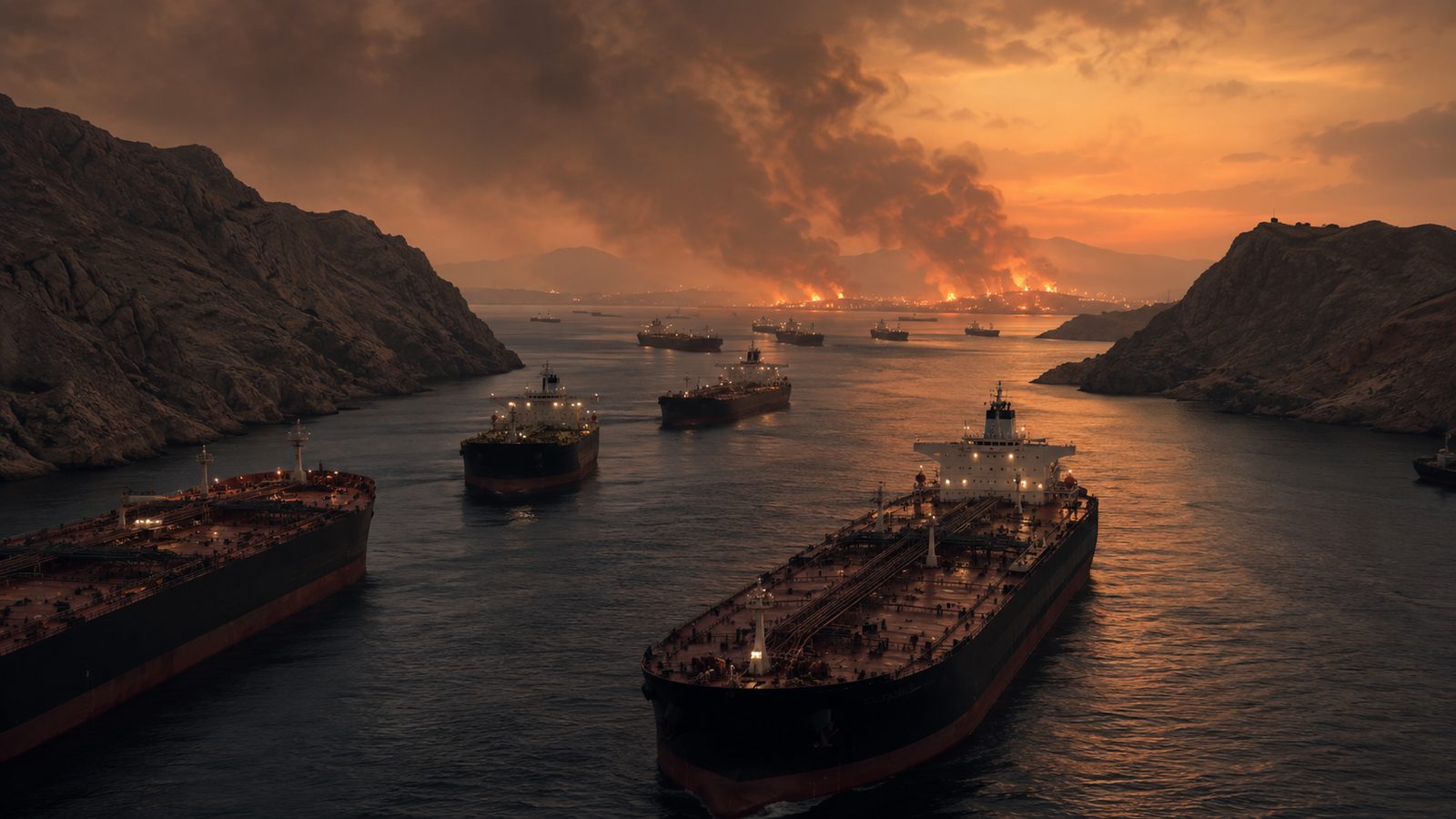
The Strait of Hormuz is the narrow passage through which roughly a fifth of the world's oil and gas had historically moved. In February 2026 an average of 135 vessels crossed it every day. After the twenty-eighth of that month, when the United States and Israel struck Iran and Iran answered by closing the water, the count fell to single digits and stayed there. Some days a dozen. Some days none.
America still had oil. America produced oil. But look at where the cushion went.
Before the strike the Strategic Petroleum Reserve held about 415 million barrels. In March the President authorized a release of 172 million, part of a coordinated international mobilization of 400 million — the largest emergency stock release ever attempted. By the week ending August 7, the reserve stood at 298.7 million barrels: 41.8 percent of authorized capacity, and the lowest level since January 1983.
Two details in the fine print. Most of it wasn't sold, it was lent — contracted out to companies obliged to return the same volume later, with repayment premiums running as high as twenty-eight percent. And the government's own auditors had reported that more than a quarter of the reserve couldn't be drawn at all, that it could only be emptied at about sixty percent of its designed rate, and refilled at barely more than half.
Meanwhile commercial crude tanks were full. That same week they posted their largest build since January 2023.
Which is the whole thing in miniature. The buffer everybody watched looked fine. The buffer of last resort was down to its 1983 level and could not be refilled quickly at any price.
Nothing had collapsed. That was the important part. Everything still worked. Gas stations opened in the morning. Credit cards cleared. Packages arrived. The Dow went up. People argued about politics online.
The fuse was burning somewhere most Americans couldn't see.
the-fuse-has-been-lit-hormuz-tankers.jpgThe second fuse was in Tokyo
The world had spent years watching China. Everyone assumed that if America's debt problem ever became an international weapon, China would be the country to use it.
They were looking in the wrong direction.
Japan was America's largest foreign holder of Treasury securities. At the end of May 2026 it held $1.1143 trillion — down $66.7 billion in that month alone, the steepest monthly decline by any single country in nearly four years. Roughly ninety percent of the selling was in short-term bills rather than long bonds, which is the polite way to raise cash without announcing anything.
It needed the cash because the yen was breaking. It reached a nearly forty-year low around 164 to the dollar before Washington and Tokyo intervened jointly — the first time the two had bought yen together since 1998 — and pushed it back toward 157. Tokyo's finance ministry said it would not hesitate to do it again.
This was no longer merely Japan's problem, and Washington understood what sat underneath it. Defending the yen took dollars, and one way to get dollars was to sell the American government debt sitting in reserve. Sell enough Treasuries and prices fall. When prices fall, yields rise. When yields rise, America's cost of borrowing rises — against roughly $40 trillion of it.
Which is why Washington joined in, and why the two governments spent the following week pointing at a Federal Reserve facility that lets a foreign central bank borrow dollars against its Treasuries instead of selling them. Analysts called the American participation self-preservation, and were not being unkind. Nobody was hiding the reasoning.
The United States wasn't helping an ally defend its currency.
It was protecting the bond beneath it.
The glue
For decades the arrangement had worked beautifully. America bought. The world produced. America ran deficits, the world accumulated dollars, and those dollars came back into American markets, including Treasury bonds. America could borrow because somebody was always willing to lend.
Japan was one of the quiet pillars holding that architecture up. Nobody called it the glue because nobody notices glue until something starts coming apart.
Now Japan had its own problem, and every move damaged something else. A collapsing yen made imported energy more expensive. Raising rates threatened its enormous domestic debt. Keeping rates low weakened the yen further. Selling reserves could support the currency, but selling too many Treasuries risked breaking America's bond market.
The United States had the identical problem from the opposite direction. Higher rates supported the dollar and fought inflation, and raised the cost of refinancing the debt. Lower rates protected the financial system, and weakened the dollar.
Japan couldn't move. America couldn't move. So they stared at each other across the Pacific while markets pushed harder.
A game of chicken played with two currencies and several trillion dollars of sovereign debt.
And they were playing it inside a wider war — not one war but several. Ukraine still grinding on. The Middle East threatening energy, currency markets threatening Japan, bond markets threatening Washington. Sanctions, blockades, tariffs and access to capital had become weapons alongside missiles and drones. Not a world war in the traditional sense. A world economic war, in which everybody believed the other side would blink first.
The false rebound
Then stocks fell. Not catastrophically. At first.
Seven percent. Then nine.
The financial networks filled with explanations. Hormuz. Oil. Japan. Inflation. Treasury yields. Algorithmic trading. The Federal Reserve issued a statement, and the market rallied.
It was magnificent. Stocks recovered half their losses in four sessions. Anchors called it historic. Analysts announced the buying opportunity of a generation. Retail piled back in. Retirement accounts recovered. Everybody exhaled.
Then it fell again. Another intervention. Another rally, stronger than the last.
That became the pattern. Collapse. Intervention. Relief. Collapse. Intervention. Relief. Each rescue required more money than the previous rescue, because each rescue convinced fewer people.
By October, the markets weren't trading economics anymore. They were trading confidence.
Confidence has no reserve account. Once it is spent, a central bank cannot print it.
Everybody wanted dollars
Here is the part that confuses people looking back, because it runs the wrong way.
The first phase of a dollar crisis is a shortage of dollars.
It had happened in 2008 and again in 2020. When the world becomes frightened, it does not sell dollars — it scrambles for them. Debts are denominated in dollars. Cargoes are priced in dollars. Margin is posted in dollars. Every institution on earth with a dollar obligation and no dollar income reaches for the same currency at the same moment, and the Federal Reserve opens swap lines to keep the plumbing from seizing.
So as the strait closed and the yen broke and the market fell, money ran toward America. The dollar index climbed. Treasury auctions cleared. Officials pointed at the inflows as proof the system was sound.
They weren't wrong about the mechanism. They were wrong about what it meant.
A flight to safety only works while the thing you are fleeing to is not the thing you are frightened of. The world was running into the dollar because of what was happening in the Gulf and in Tokyo.
Then the thing everyone was frightened of became the dollar itself, and the exits were on the wrong side of the room.
The break
The failure came on a Monday morning. Nobody knew exactly what happened.
Brokerage platforms reported intermittent outages before the opening bell. A large payment processor went offline. Two banks reported connectivity issues. Treasury trading became disorderly. Then rumors that several major institutions could not calculate collateral requirements, because prices were moving too fast to price against.
The official explanation came within hours: a sophisticated cyberattack. Foreign actors. Critical infrastructure. Systems compromised. The public was told not to panic.
That was when everyone panicked.
Banks experienced a digital run. Nobody stood outside a branch the way they had in 1930. They tapped screens. Transfer. Transfer. Transfer. Millions of people trying at once to move imaginary numbers from one database to another.
The systems slowed. Then limits appeared. Then maintenance notices. Then the screens went dark.
The cyberattack may have been real. It wasn't the reason the system closed. The system closed because there was no longer enough liquidity behind the promises, and the hacking became the explanation because nobody could put the real one on television:
The leverage broke.
The bank holiday
The President addressed the country that night. Markets would remain closed temporarily. Banks would operate under emergency rules. Certain electronic transfers would be limited. Americans were asked to stay home unless travel was essential. Deposits, officials insisted, were safe.
National Guard units appeared around financial centers, fuel terminals and power stations.
Nobody called it martial law. Not yet. The terminology was softer. Emergency stabilization. Critical infrastructure protection. Temporary movement restrictions. National continuity measures.
The distinction mattered less with each passing day.
Markets did not reopen Tuesday. Or Wednesday. By Friday everyone understood that this wasn't a long weekend.
November 3
The 2026 federal midterm election was scheduled for November 3.
It never happened.
That was the moment the financial crisis became a constitutional one. The government announced that the combination of cyberattacks, communications failures, banking disruption and emergency restrictions made a secure national election impossible.
Governors sued. States resisted. Courts issued contradictory orders. Emergency powers expanded. Military units deployed in several cities after unrest around banks and fuel depots.
The country didn't wake up one morning and discover that democracy had been abolished. It happened through a hundred temporary decisions. Each one had an explanation. Each one lasted just a little longer than originally promised.
The information problem
Then officials discovered another problem. Information moved faster than government.
A rumor that one bank was insolvent sent customers to withdraw, which made the rumor true. Videos of empty stores emptied stores that weren't. A fake video moved markets before anyone could prove it was fake.
Platforms were restricted during declared emergency periods. Some disappeared. The open internet didn't vanish overnight — it became unreliable, then inconvenient, then dangerous, while government services and banks and digital identification all worked perfectly well on the approved networks.
Control didn't arrive by banning the old system. Control arrived by making the new system the only one that reliably worked.
The Fed's last choice
Meanwhile, behind everything visible to the public sat the problem that had caused the crisis in the first place.
Debt.
The Treasury still had bonds maturing. Social Security checks still had to clear. Soldiers still had to be paid. The federal government could not simply stop spending.
But buyers no longer wanted enough Treasury debt at rates Washington could survive. There were two choices: let rates rise until somebody bought the bonds, or manufacture the buyer.
The Federal Reserve became the buyer.
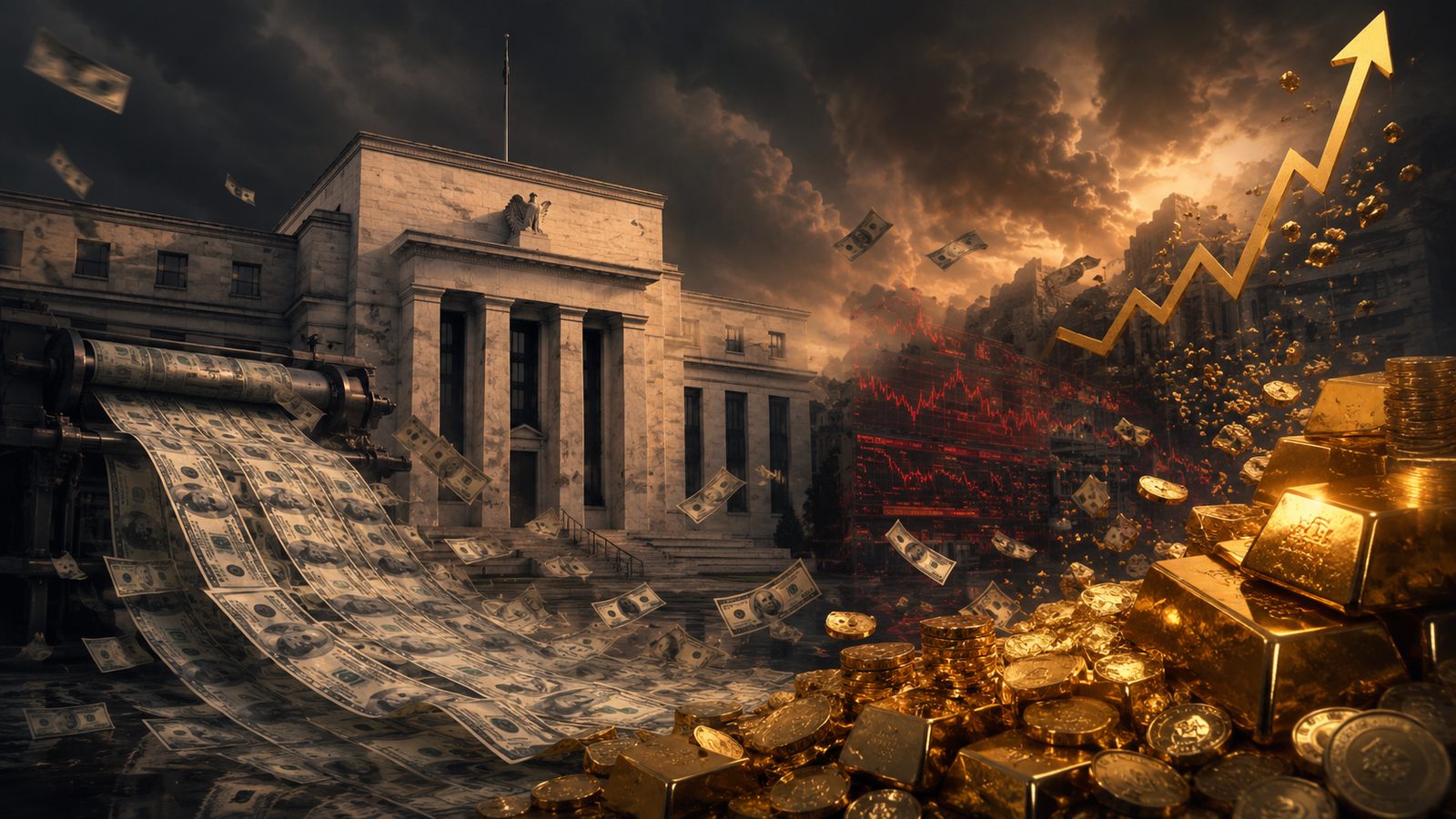
At first it was temporary market stabilization. Then liquidity assistance. Then emergency asset purchases. Then yield stabilization. Eventually nobody bothered changing the terminology; the numbers simply got larger. Hundreds of billions. Trillions. More trillions.
The debt had not disappeared. Something stranger had happened.
The dollar had begun disappearing underneath it.
the-fuse-has-been-lit-fed-printing-gold.jpgGold
Gold reached $10,000. Commentators called it absurd. Then $20,000. Then $50,000.
At $50,000 an ounce, America's roughly 261.5 million ounces of government gold carried a nominal value of about $13 trillion. At $150,000, it approached $40 trillion.
But nobody became richer. Bread cost more. So did gasoline, a house, a truck, a day's labor.
Gold hadn't performed a magic trick. The ruler had changed length.
That became the central realization of the crisis: the United States did not have to find $40 trillion of today's dollars to escape $40 trillion of yesterday's debt. It only had to destroy enough of yesterday's dollar.
Creditors received what they were promised. Dollars. They simply weren't the dollars they thought they were lending.
The assets
America had been slower to the table than the others, and then it arrived all at once.
Underneath the whole maneuver sat a premise nobody could prove and everybody was acting on regardless: that the dollar was going anyway. Not because of a decision — because of the arithmetic. Permanent deficits, permanent monetary expansion, a creditor base that kept getting smaller and more nervous. Grant that premise and the question was never whether to let the old system fail. It was only what you were holding when it did.
So the dollar had to die while the United States still held what the next system could not print. Land. Oil. Gas. Gold. Fresh water. Minerals. Food. Ports. Military reach.
Which changed the way people later read the obsession with Greenland, Canada and Venezuela. Greenland wasn't ice — it was rare earths, strategic territory and an Arctic corridor. Canada was one of the largest combinations of land, freshwater, uranium, potash, oil and mineral wealth on Earth. Venezuela sat on roughly 303 billion barrels of proved crude on paper, the largest reported reserve base in the world.
Cuba was never about Cuba. It was about the approaches to the Gulf of Mexico.
And the tariffs, which had been read for years as a trade policy, were re-read as something else entirely: not a way to win a negotiation but a way to drag production, supply chains and strategic dependence toward the continent while the old currency still had the leverage to drag them.
For years the talk of territorial expansion and hemispheric control had been treated as theater. After the reset it looked like a man moving his hand up the bat.
What the record showed, of course, was the opposite. The stated policy was a strong dollar. In January 2026 the Treasury Secretary said so plainly on television — that the United States always has a strong dollar policy, that it means setting the right fundamentals, that sound policy would bring the money in. He said it the day after the President had been asked about the currency sliding to a four-year low and answered that he thought it was great.
Both statements were on the record. Both men were in the same administration. The dollar fell, rose half a percent on the Secretary's reassurance, and resumed falling the following day while gold, silver and copper went to records.
You maintain that the dollar must remain strong right up until the morning you no longer need the old dollar. What else would you say?
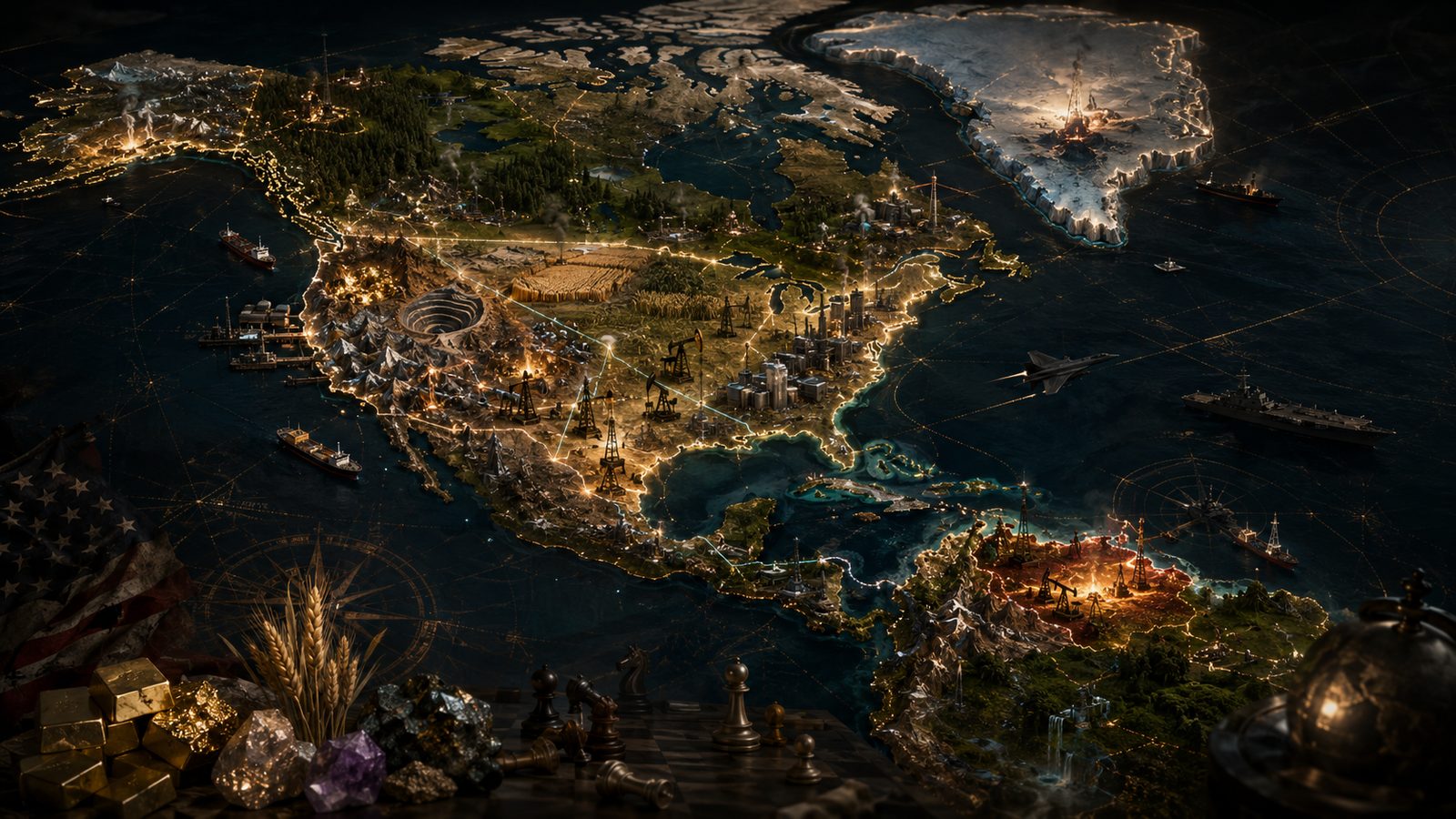
the-fuse-has-been-lit-resource-map.jpgAmerica had spent generations accumulating paper liabilities. Now it was accumulating things.
The dollar was the liability. The hemisphere was the asset.
And it was not the only government doing arithmetic. China had spent the same years filling a strategic petroleum reserve with discounted crude, running pipelines overland through Central Asia, and electrifying whatever could be electrified. When the strait went quiet it had months of cover, a land route and a second supplier — and it turned around and sold the rest of Asia the equipment to survive what it had already survived.
Two governments reading the same arithmetic and reaching for different chairs.
The first reset
People eventually looked even farther backward. To 2020.
COVID had seemed like an event belonging to another lifetime. Businesses closed. Governments borrowed trillions. Checks appeared in accounts without anyone walking into a bank. Work, school, commerce and medicine all moved onto screens.
At the time people called it temporary. Years later they would call it Phase One.
Not because the pandemic had been created for some hidden purpose — but because it demonstrated what was possible. A government could close an economy. The Federal Reserve could create trillions. Congress could pay people directly. And the financial system kept functioning while much of the physical economy stood still.
The infrastructure of a reset had been tested without anyone calling it a reset.
The dollar had to die
By 2026, the problem was no longer whether the dollar could be saved. The problem was what saving it would cost.
Preserving the old dollar meant preserving the real value of nearly $40 trillion of federal debt. That meant taxpayers not yet born would spend their lives servicing promises made decades earlier.
Eventually the political calculation changed. Perhaps the debt did not have to be repaid. Perhaps the currency in which the debt was denominated had to be retired instead.
That distinction changed everything, because it worked in both directions at once. Gold at $150,000 an ounce. Oil repriced. Minerals, land, energy repriced. America's liabilities stayed written in yesterday's dollars while its assets began trading in tomorrow's prices.
The debt wasn't paid. It was passed through the fire.
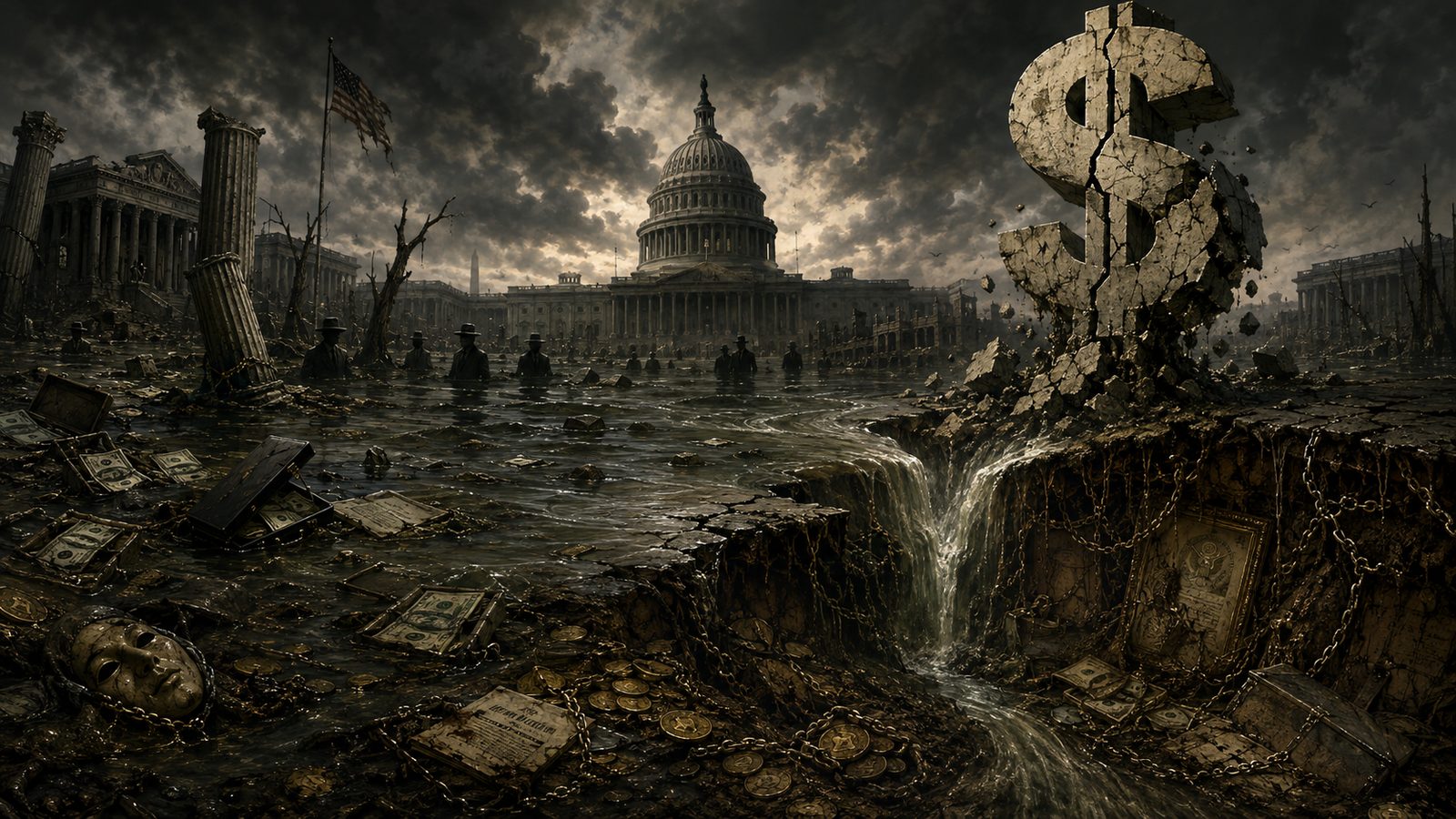
the-fuse-has-been-lit-dollar-crumbles.jpgThe question of the strait
Which returns the whole thing to the water it started in.
The obvious reading was that the war caused the crisis. The strait closed, oil repriced, everything downstream followed.
Some people ran the sequence backwards instead.
The strait had not closed itself. The United States and Israel struck first. Iran shut the water in retaliation. Whatever else was true, the American hand was at the front of the chain, not the back of it.
The argument against reading intent into that was straightforward, and for a long time it was the majority view. Everything that followed was American effort to reopen the passage. A blockade. Escort operations. Round after round of talks Tehran rejected. Eighteen months of expensive, public, humiliating attempts to get the tankers moving. Nobody strangles a chokepoint and then spends a year and a half begging it to breathe.
The people who disagreed had one answer and never needed a second.
You cannot be seen to want the fire you started.
Every escort mission was evidence of good faith. Every rejected negotiation established who the reasonable party was. And none of it cost anything, because the strait stayed shut regardless. The effort wasn't a contradiction of the plan. The effort was the alibi.
Then they would list what the closure accomplished. Oil repriced. Energy importers squeezed hardest, Japan first among them. The yen broke faster than it otherwise would have. Japan reached for dollars, and sold Treasuries to get them. The bond market took the pressure, and the pressure went where it was always going to go.
Every domino stood in exactly the order it fell.
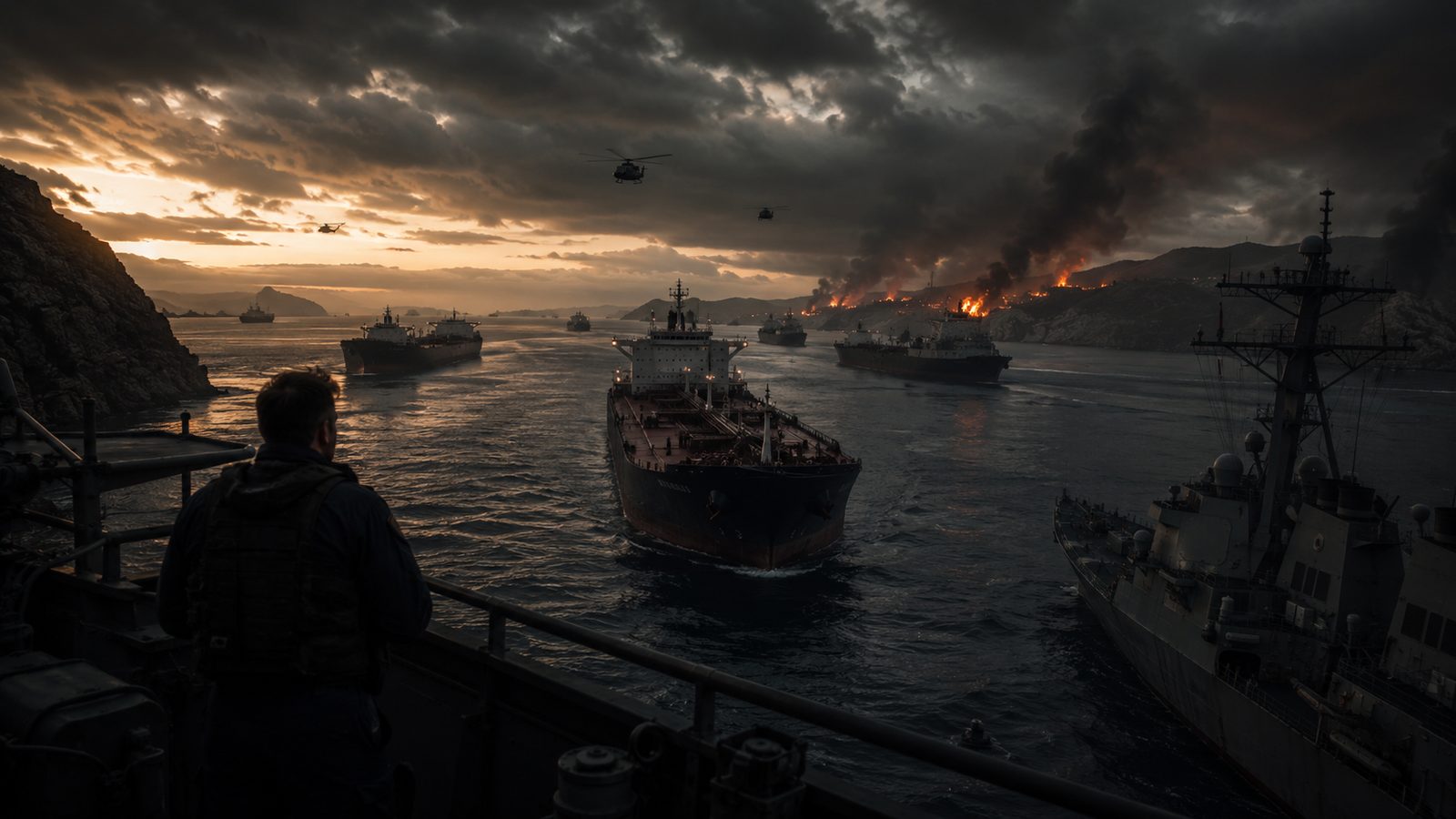
the-fuse-has-been-lit-strait-escort.jpgNobody ever found a document. No memo, no recording, no minutes, no witness who had been in the room. What the argument had was a sequence, and a set of outcomes too neatly aligned to look like weather.
And the uncomfortable part, which its own believers never liked saying out loud, was that the sequence looked identical if nobody had intended any of it.
A plan and an accident leave the same wreckage. That is why the question could never be closed, and why both sides could keep pointing at the identical set of facts for the rest of their lives.
The face
And everyone blamed the President. Not for the strait — for everything.
The crash. The confrontation with Iran. The Treasury crisis. The emergency government. The vanished midterms, the troops in American cities, the internet that changed, the dollar that went. And the open treatment of Greenland, Canada, Venezuela and the hemisphere itself as strategic assets rather than places on a map.
For years his name was shorthand for the destruction of the old order.
Then history got complicated.
Because an argument emerged that he hadn't destroyed American democracy in order to replace it — that he had presided over the destruction of the financial system that was going to destroy democracy anyway. Servicing the old order had come to require permanent debt, permanent monetary expansion and steadily more desperate intervention. Something had to break.
He let the old system break. Or perhaps he accelerated it. The distinction would be debated for generations.
His defenders would make an extraordinary claim: he had saved the republic by allowing the system around it to fall. Nobody burns down a house because he hates the house, they said. You stop paying to prop up one whose foundation is already gone, and you carry out what matters before the roof comes down.
His critics answered that this was the oldest defense arson ever had. That the foundation was a forecast and not a finding — that Americans had been told for three generations the debt would kill them and it hadn't yet. And that a man who profits from a collapse he predicted is not thereby proven to have predicted it honestly.
Both sides had evidence. Neither would ever completely win.
This account leaves his name out. Not from delicacy. Supplying it is the shortcut everybody took, and the shortcut is the thing being described.
The reset
The negotiations took almost two years. America. Europe. Japan. China. The Gulf states. The banks, commercial and central.
The bargaining wasn't about ideology. It was about what everybody actually possessed — energy, food, factories, technology, minerals, gold, protection, land, debt.
America came to the table as the largest debtor in the system and one of the richest collections of physical assets on the planet at the same time.
That contradiction became its leverage.
The new currency arrived as the solution to the chaos. Digital. Instant. Government-backed. Banks stayed in the system, but every unit moved through a common settlement network.
Old dollars were exchanged for new units under conversion rules that varied by account type. Small deposits got one treatment, large deposits another. Treasury securities were converted separately. Pensions were indexed. Mortgages were rewritten. Some debts disappeared. Others survived.
Some people emerged nearly whole. Others found that thirty years of savings had become purchasing power worth a fraction of what they expected.
Nobody officially called it a default, or confiscation, or hyperinflation. The vocabulary was cleaner. Monetary modernization. Debt restructuring. Digital transition. Emergency stabilization.
Default. Confiscation. Hyperinflation.
Two years later
The restaurants reopened. Planes flew. Stores had food. Children went back to school. Markets traded again. Eventually elections returned.
America still existed. That surprised people.
Washington still stood, Congress still met, courts still issued decisions and people still argued about presidents. But almost everything underneath those familiar institutions had changed.
Cash had nearly disappeared. Money was digital. The old Treasury market was gone. The debt had been restructured. The dollar survived mostly as a name. And national power was understood in resources now — energy, minerals, food, technology, geography, reach.
People spent the rest of their lives arguing over what had happened. Some blamed Japan, or Iran, or Russia, or the Federal Reserve, or Wall Street, or Washington. Almost everyone blamed the President. That was easier.
History likes a face. Markets don't have faces. Debt doesn't have a face. A hundred years of accumulated promises don't have a face.
A president does.
Only decades later did the harder questions get asked. What if no president could have saved the old system, and preserving it would only have postponed the same reckoning? What if the man accused of ending American democracy helped preserve it by letting the monetary architecture underneath it die?
Nobody ever settled that. And the answer historians kept circling back to was the least satisfying one available: nobody had planned any of it. Everyone had been protecting themselves. Japan protected the yen. America protected the Treasury market. The Fed protected the banks. Politicians protected their power. Each solution moved the pressure somewhere else, and once enough had accumulated, one small disruption could travel through currencies, bonds, banks, governments and finally society itself.
Which is why the collapse looked impossible right up until the moment it happened.
The stock-market crash wasn't the beginning. Neither were the bank closures, the canceled election, the digital currency. Even COVID wasn't the beginning.
Those were points on a line stretching back through decades of deficits, bailouts, wars, monetary expansion and promises that could never all be honored at the value at which they were made. Back past 1971, to a navy, an oil company and a gate.
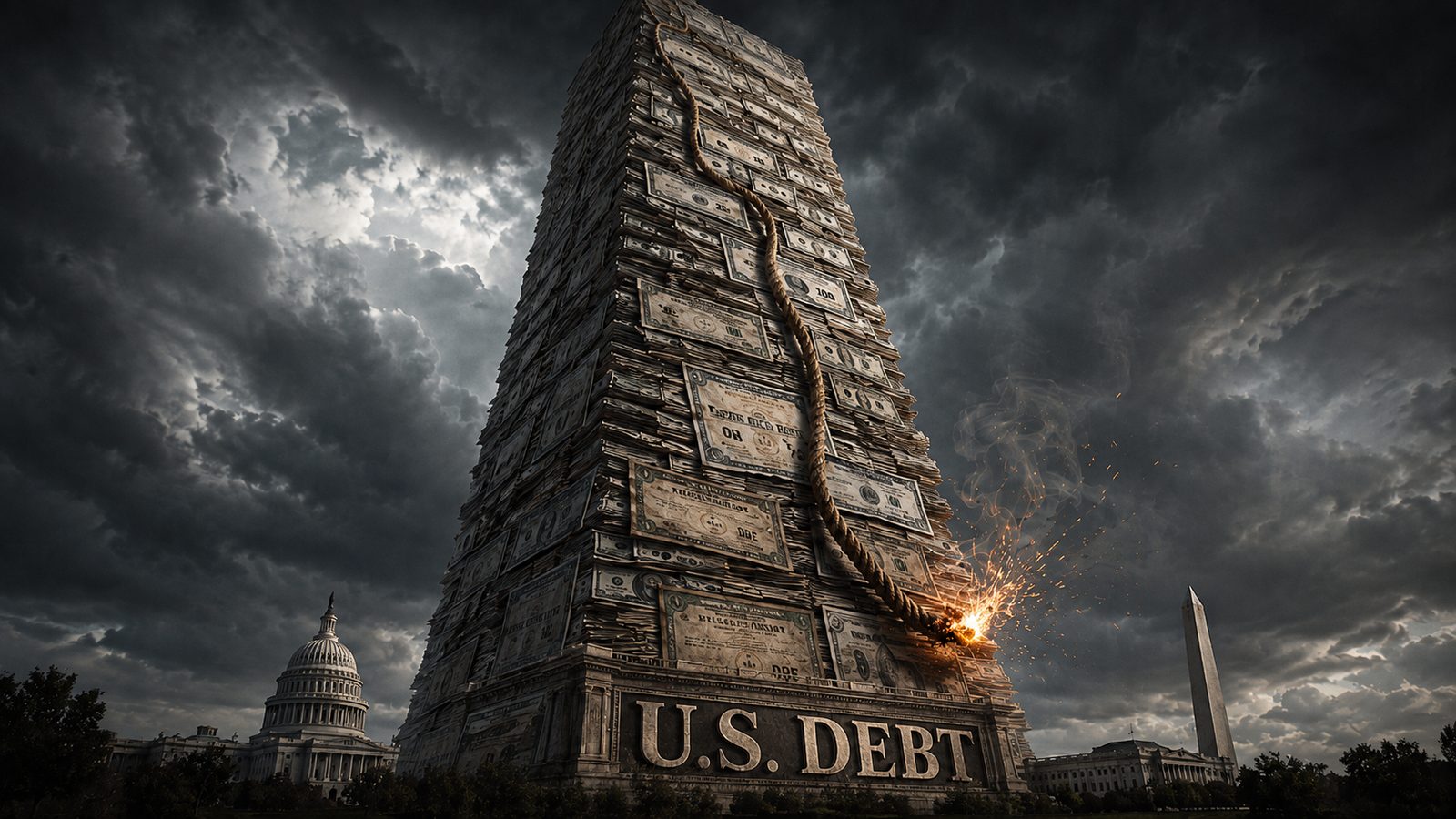
Near the end, the signs became easier to see. A weakening currency in Tokyo. A Treasury bond being sold. An oil tanker waiting where it once would have sailed straight through. A tower of American debt reaching so high that nobody could imagine paying it down.
And a small flame, almost at the end of the cord.
By the time everyone finally looked up —
the fuse had already been lit.
What it was for
The mistake was thinking independence was the end of the story.
The first one broke a political dependence. The second broke a financial one — chokepoints, supply lines, permanent debt, an architecture built for a century that had already ended. But independence from a thing is worth nothing by itself. It only counts as permission to build the next thing.
And the resource that turned out to matter was not gold, or oil, or land.
It was electricity.
Artificial intelligence had quietly changed what a megawatt was for. A barrel of oil moved a truck. A megawatt feeding a data center made computation, and computation was turning into discovery, medicine, logistics, weapons and productivity all at once. The constraint was never the chips. It was the grid — four to ten years to connect a building that took two years to put up.
So the hemisphere read differently a second time. Hydro and uranium in the north. Gas and nuclear in the middle. Copper for the lines, factories for the transformers, land for the buildings, water to cool them.
Not an energy balance sheet. A compute balance sheet.
The dollar was the liability. The hemisphere was the asset. It took a collapse for anyone to notice the asset's highest use was electrons.
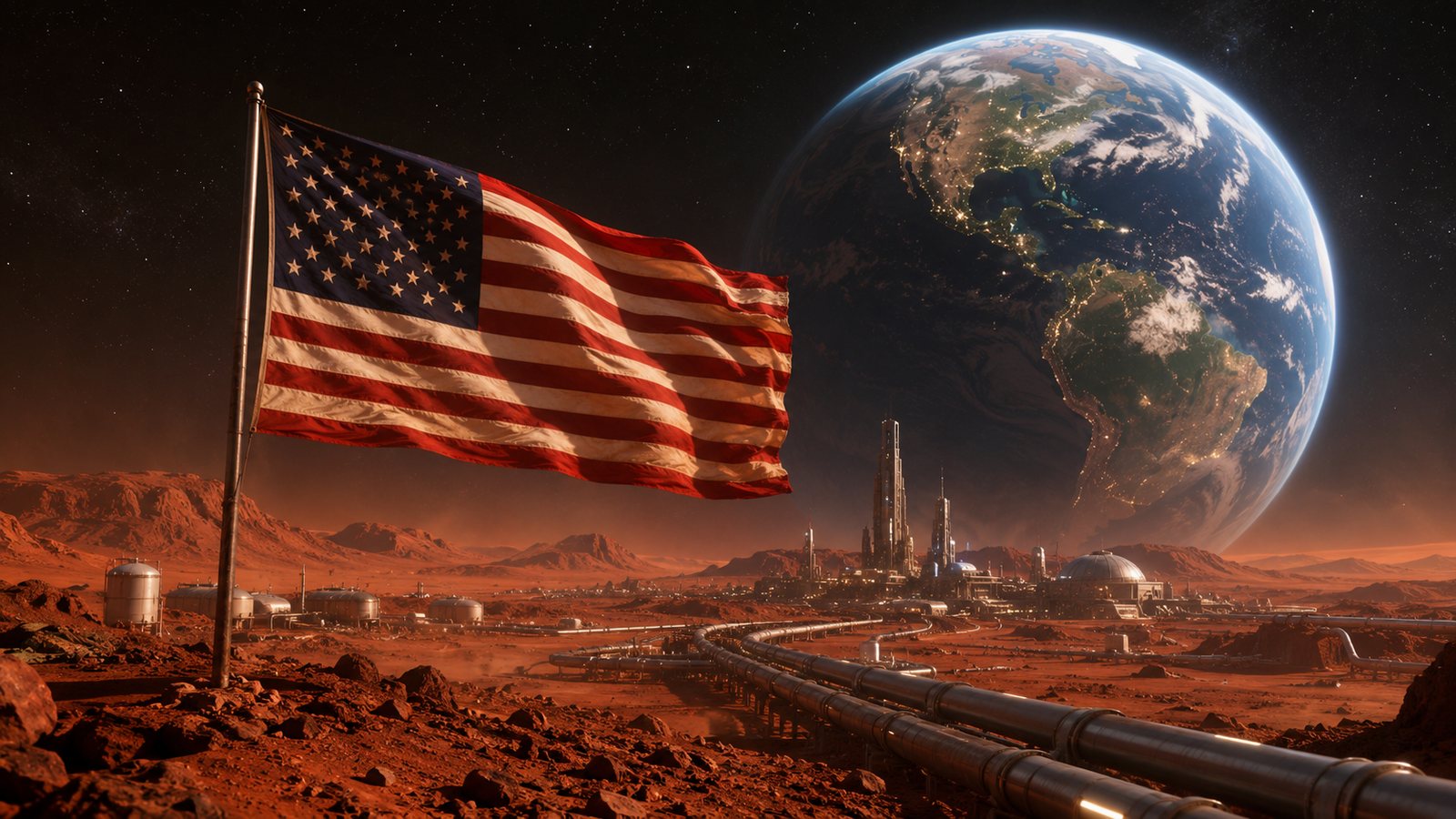
And Mars was never about bringing anything home. Earth has rocks.
Mars mattered because a civilization needs somewhere to point. America pointed west for two centuries, ran out of west, and then somebody looked up.
Because a country that can only see decline becomes a country that administers decline. It stops building and starts rationing. The argument turns from what to make into who gets what's left. And a society that has stopped imagining its future has already handed over part of it, without a vote, without a headline, without anyone naming the day.
Which is worth saying plainly, because it is the argument the whole thing was about.
Authoritarian government does not arrive because a people stop loving freedom. It arrives because they stop believing there is enough. Scarcity is the precondition. When the future looks smaller than the past, protection begins to sound more reasonable than liberty, and somebody always volunteers to supply it. You may do this. You may not do that. Order, bought by narrowing the horizon.
So the test of those years was never whether the country could avoid the dark part. It was whether it could pass through the dark part without becoming the thing that had frightened it into the passage.
It nearly didn't. A federal election was canceled and no argument makes that all right. Soldiers stood outside banks in American cities. The networks that carried the country's arguments were throttled and then rebuilt on terms nobody voted for. The people who said the republic would not survive weren't being hysterical. They were reading the evidence in front of them.
But the courts kept sitting. Congress kept meeting. The elections came back. And people went on starting companies and building machines and being loudly, expensively wrong in public without asking anyone's permission to try again.
Held is a smaller word than saved. Held is what happened.
And a country that has just discovered its horizon is open behaves nothing like one convinced it is closing. It stops rationing and starts building. Nobody explores and cowers at the same time — the two will not fit inside the same person, which is the entire reason the horizon matters.
Which leaves the one question the reset never answered.
We're independent of it now.
What are we going to build?
Fictional?